---
title: "Why You Should Embrace the Promotions Tab"
slug: why-you-should-embrace-promotions-tab-gmail
description: "Gmail’s Promotions tab is not a penalty. It can improve engagement, protect sender reputation, and optimize long-term email performance."
created_at: "2026-01-16"
updated_at: "2026-01-16"
image: https://cdn.resend.com/posts/why-you-should-embrace-promotions-tab-gmail.jpg
humans: ["jp-valery"]
category: "guides"
featured: true
---
Many email inboxes auto-sort mail by intent. And it's been happening for a while.
- **Gmail** introduced tabbed inboxes in 2013.
- **Yahoo Mail** launched a recent activities tab in 2013.
- **Outlook** unveiled its focused inbox in 2017.
- **Apple** followed with tabbed inboxes in 2024.
From the very beginning, many senders viewed the Gmail Promotions tab as a deliverability issue, assuming that performance decreases as soon as email leaves the Primary inbox.
**But the Promotions tab is not a penalty.**
That perception is widespread, but in reality, industry data and platform behavior indicate that for most marketing messages, **the Promotions tab benefits engagement**.
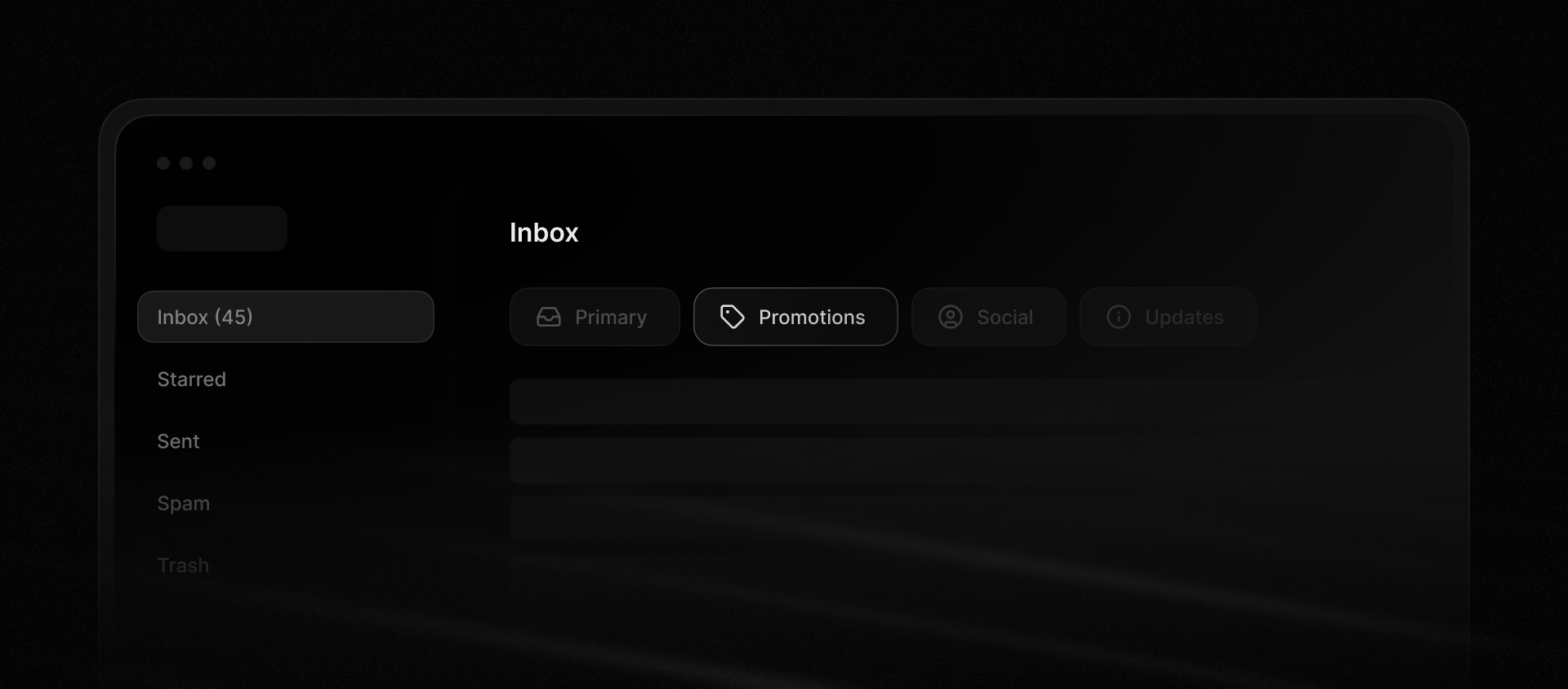 ## What the Promotions Tab Represents
Gmail introduced tabbed inboxes to sort messages by intent rather than to penalize marketing emails. Each tab is designed to contain a specific type of message.
- **Primary tab**: contains person-to-person communication and important individual messages.
- **Promotions tab**: groups commercial announcements, offers, newsletters, product releases, and marketing sequences.
- **Social tab**: contains messages from social networks or messaging apps.
Multiple major actors of the email industry have consistently shown that **landing in Promotions is not a spam signal**, but a classification aligned with expected content types.
Emails can appear in the Promotions tab even when authentication, content quality, and list health meet best practices.
## Why Landing in Promotions Is Not a Negative Signal
Marketers often assume that visibility decreases when messages enter Promotions. However, email analytics platforms repeatedly report that **subscribers enter Promotions intentionally** to browse offers, updates, and product content.
Data-driven insights:
## What the Promotions Tab Represents
Gmail introduced tabbed inboxes to sort messages by intent rather than to penalize marketing emails. Each tab is designed to contain a specific type of message.
- **Primary tab**: contains person-to-person communication and important individual messages.
- **Promotions tab**: groups commercial announcements, offers, newsletters, product releases, and marketing sequences.
- **Social tab**: contains messages from social networks or messaging apps.
Multiple major actors of the email industry have consistently shown that **landing in Promotions is not a spam signal**, but a classification aligned with expected content types.
Emails can appear in the Promotions tab even when authentication, content quality, and list health meet best practices.
## Why Landing in Promotions Is Not a Negative Signal
Marketers often assume that visibility decreases when messages enter Promotions. However, email analytics platforms repeatedly report that **subscribers enter Promotions intentionally** to browse offers, updates, and product content.
Data-driven insights:
* **[SendGrid data](https://www.twilio.com/en-us/blog/insights/fought-gmail-tabs)**: comparable click-through behavior for similar user intent
* **[Litmus evaluations](https://www.litmus.com/blog/how-to-utilize-gmail-promotions-tab)**: positive engagement when you optimize for Promotions
* **[Sendigram study](https://sendigram.com/blog/gmail-tabs-promotions-tab/)**: benefits of Promotions and how to make the most of it
Rather than interrupting a user in their Primary inbox, messages surface at a time when that user expects to see them. The overall performance is improved when emails land in the Promotions tab:
- Increased open rates
- Increased click rates
- Increased conversions
- Decreased unsubscribe rates
- Decreased spam complaint rates
Across these perspectives, one pattern is consistent: **fighting Gmail’s classification rarely improves outcome**.
## Avoiding Promotions Can Harm Long-Term Deliverability
Marketers or companies often try to "force" Primary placement by using unnatural formatting or patterns that Gmail interprets negatively:
* inconsistent sending behavior
* overly minimal formatting or artificial personalization
* sudden changes in message design to influence categorization
* mismatched identity (e.g. promotional content from a personal email address)
Repeated attempts to misrepresent your email message type and trick mailbox algorithms **degrades trust** and has the **opposite impact on your deliverability**:
* stricter filtering
* lower engagement rates
* higher inactivity among recipients
* increased spam complaint probability
## The Promotions Tab Offers Features That Benefit Senders
When you land in Promotions, you can use unique marketing features:
* expirations
* deal annotations
* visual branding elements
* differentiated preview formatting
These attributes increase scannability in inbox view.
Although implementation requires structured markup, they offer a distinct advantage for those who embrace Promotions. The tab is an official supported marketing surface intended to engage with users.
## Targeting Inbox Placement That Aligns with Lifecycle Context
Inbox behavior is not uniform across all message types. Inboxes sort emails as they arrive according to their context and intent.
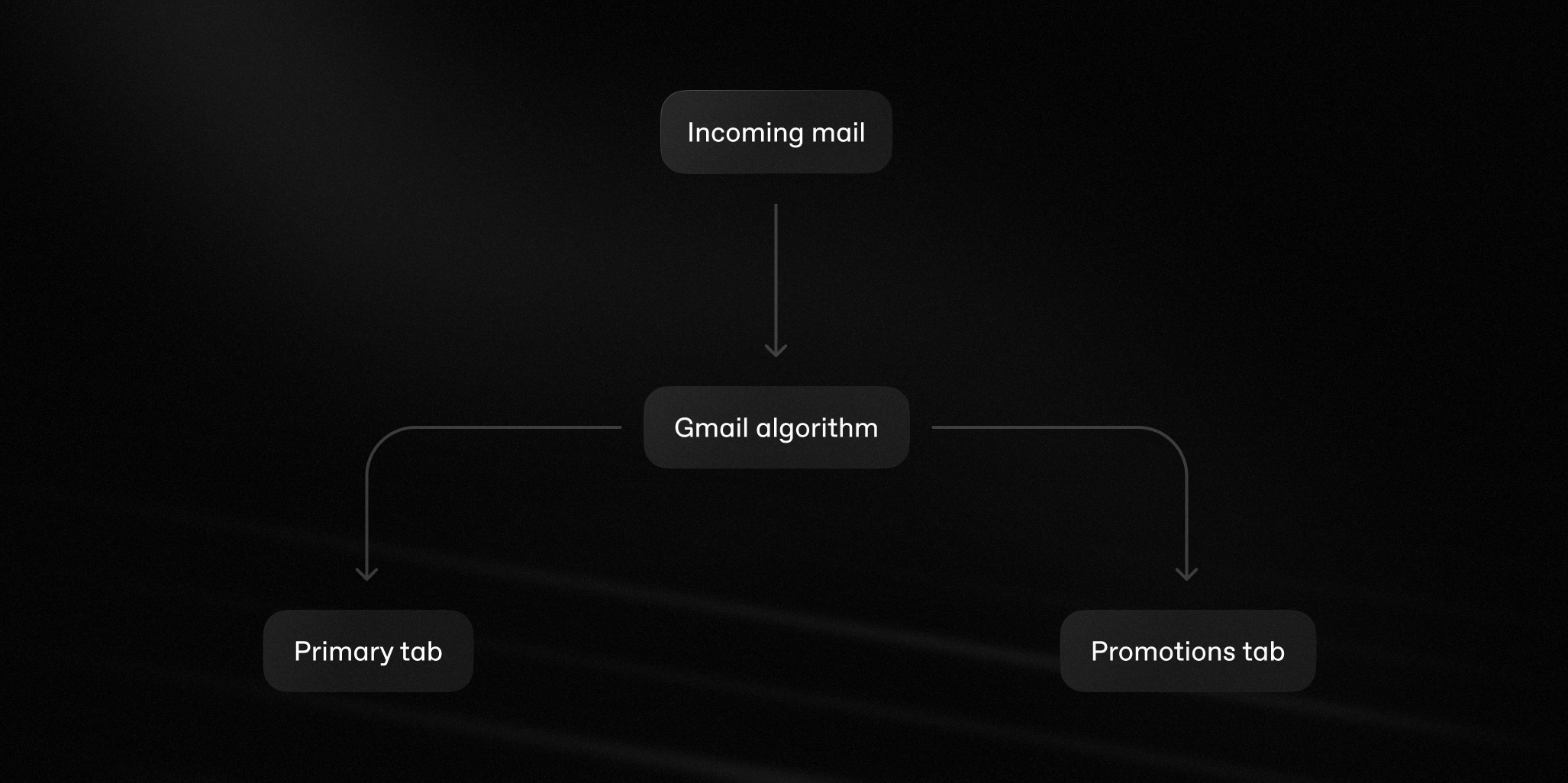 - **Primary tab**: Certain communications are inherently more appropriate for Primary, not because they are “better,” but because they are **user-initiated or transactional**: password resets, account verification messages, system alerts, or receipts and billing confirmations.
- **Promotions tab**: Other messages fit Promotions because they are **broadcast-driven**: new product announcements, seasonal offers, newsletters, content digests, or re-engagement campaigns.
Emails are sorted based on **user behavior and intent, not perceived quality**.
Inbox placement emerges naturally from user behavior. Gmail’s categorization reflects each user's behavior much more accurately than artificial sender adjustments.
## Embrace Promotions for Long-Term Deliverability
Placement in Promotions means Gmail classified the messages correctly, not that something is wrong. Your marketing emails perform best when they appear where users expect them: **in the Promotions tab**.
By embracing Promotions, senders can:
- preserve trust with inbox providers
- reduce complaint and unsubscribe rates
- encourage more predictable, value-driven engagement
- align messaging with subscriber behavior naturally
For most marketing communications, allowing Gmail to categorize messages naturally is the **strongest long-term deliverability strategy**.
- **Primary tab**: Certain communications are inherently more appropriate for Primary, not because they are “better,” but because they are **user-initiated or transactional**: password resets, account verification messages, system alerts, or receipts and billing confirmations.
- **Promotions tab**: Other messages fit Promotions because they are **broadcast-driven**: new product announcements, seasonal offers, newsletters, content digests, or re-engagement campaigns.
Emails are sorted based on **user behavior and intent, not perceived quality**.
Inbox placement emerges naturally from user behavior. Gmail’s categorization reflects each user's behavior much more accurately than artificial sender adjustments.
## Embrace Promotions for Long-Term Deliverability
Placement in Promotions means Gmail classified the messages correctly, not that something is wrong. Your marketing emails perform best when they appear where users expect them: **in the Promotions tab**.
By embracing Promotions, senders can:
- preserve trust with inbox providers
- reduce complaint and unsubscribe rates
- encourage more predictable, value-driven engagement
- align messaging with subscriber behavior naturally
For most marketing communications, allowing Gmail to categorize messages naturally is the **strongest long-term deliverability strategy**.